Beetles build with a yellow pigment gene
More than 80 years ago scientists discovered that differences in yellow pigmentation were critical to courtship success and failure for fruit flies.
It was one of the first demonstrations linking genes to complex behaviour and ever since the Yellow proteins that paint these shades in nature have been a fruitful source of scientific inquiry.
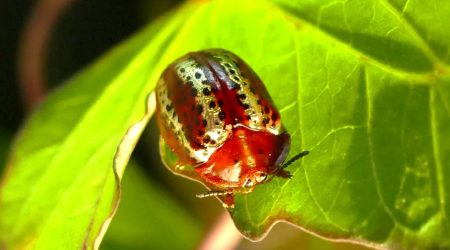
Research by the John Innes Centre, the Sainsbury Laboratory and Max Planck Institute, has added a deeper perspective to the study of Yellow, showing how in tortoise beetles this protein has been co-opted as a building material to house symbiotic bacteria.
“A protein family known for a century for pigmentation and behaviour turns out to have been repurposed for an entirely different job, sustaining a bacterial partnership the tortoise beetle cannot survive without,” said Dr Hassan Salem, a group leader at the John Innes Centre.
Tortoise beetles depend on the bacterium Candidatus Stammera to digest the pectin and cellulose in their diet of plants.
Stammera, for its part in this 60-million-year-old digestive symbiosis, has lost so much of its genome that it can barely survive on its own; its spread is dependent on the beetle.
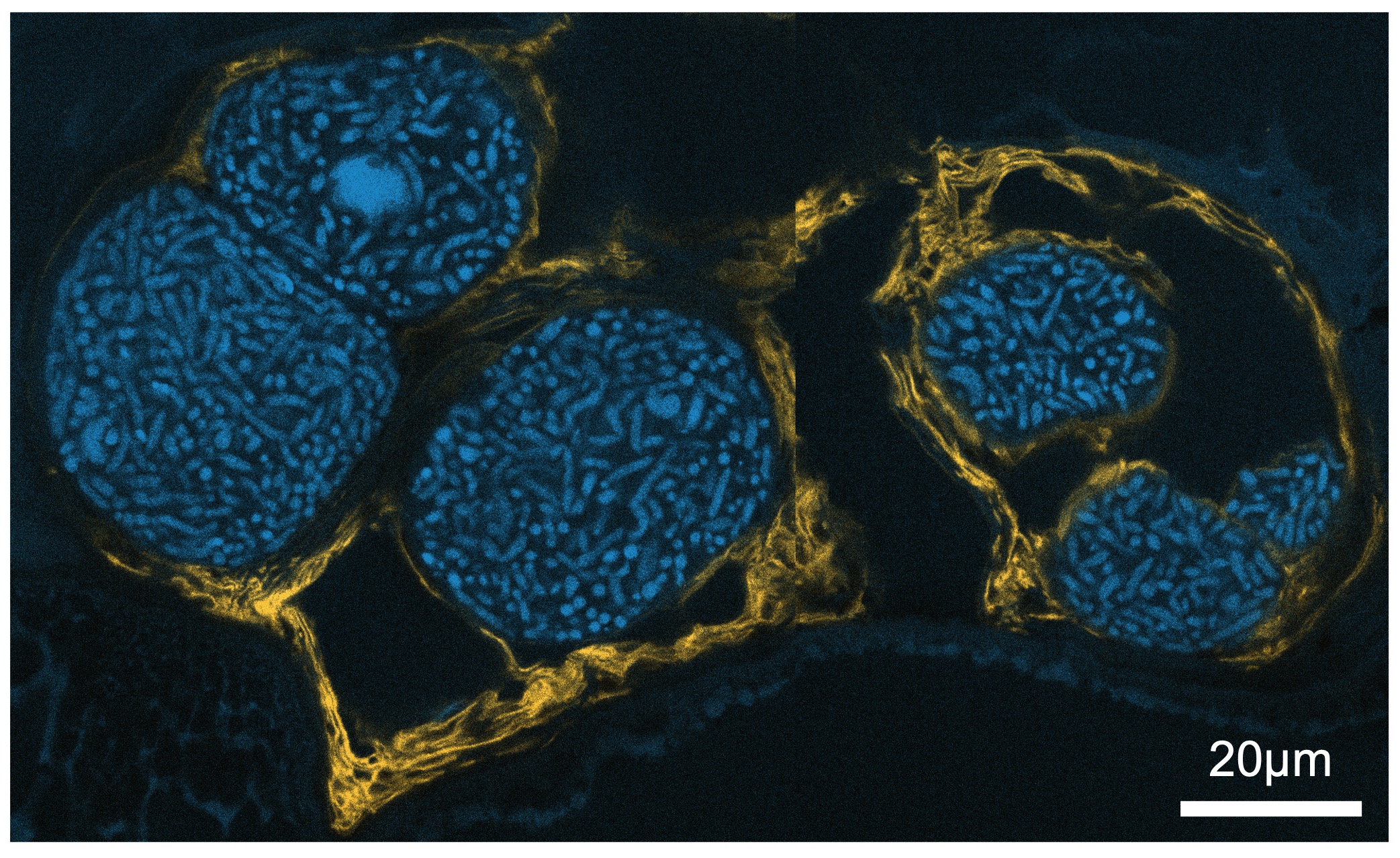
The beetle packages the bacteria into small gelatinous spheres and glues them onto the outside of each of its eggs. Here the encapsulated symbiont sits exposed for around 11 days before the beetle larva hatches and eats it along with the sphere.
The team wanted to know what these spherical structures were made from and how the beetle manages to keep a bacterium alive outside its body for so long.
To answer these scientific questions, they sequenced and assembled a reference genome for the tortoise beetle Chelymorpha alternans, the first for any tortoise beetle. Analysis showed that a gene that codes for the Yellow protein is highly expressed in the ovary-associated glands of adult females, while almost undetectable in males. It is also highly conserved across multiple tortoise beetle species.
Using lab techniques combined with mass-spectrometry, they confirmed that the Yellow protein was present in the spheres. Structural modeling approaches revealed that the spheres are built almost entirely from Yellow protein formed into a dense, glue-like matrix.
Experiments which knocked down the gene saw disruption in sphere morphology and increased the symbiont’s susceptibility to drying out.
“A tortoise beetle mother wraps her bacterial partner in a protein coat, glues it to the outside of her egg, and that coat is what keeps the bacterium alive for over a week before her offspring can consume it and become infected. It is a nice example of evolution using an old tool for a completely new purpose,” Dr Salem explained.
The study, which appears in Nature Communications, adds to a growing pattern seen in insects where existing genes, often with a long evolutionary history, are repurposed to solve a completely different challenge.
Even so, the striking findings came as a surprise. Dr Salem said: “We did not expect a gene from the Yellow family, best known for pigmentation and behavour, to be responsible for something as physical as building a protective capsule around a bacterium.”
Leaf beetles, the family to which tortoise beetles belong, are significant pests of crops, so the more we can reveal their functions the better we might disrupt their activities.
The study may also have implications for how the plant may be engineered to resist herbivory by targeting the beetle’s bacterial partner.
The next step for this research is to investigate how the Yellow protein forms the protective matrix at a biochemical level.
Yellow protein co-opted to sustain obligate symbiosis in leaf beetles, appears in Nature Communications.
Caption – Microscopy image shows Candidatus Stammera bacteria wrapped in a protective Yellow protein coat – by Dr Christiane Emmerich